Bloom's Taxonomy Of Learning

May 17, 2019 • 77 views
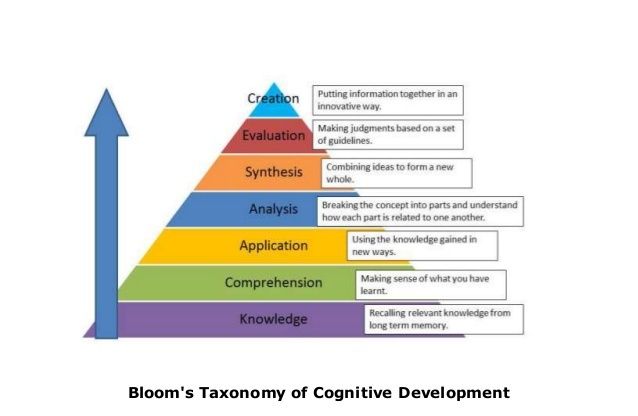
It is a hierarchical structure depicting different cognitive domains of learning anything, i.e., from lower order thinking skills to higher order thinking skills, which we call HOTS.
It was devised in 1956, under the leadership of educational physicist Dr. Benjamin Bloom to promote the HOTS among learners. These levels must be regarded as degrees of difficulty, i.e., one level must be completed before moving on to the next. This taxonomy is also used by teachers for designing curriculum, testing students, training, etc.
To do away with mere rote learning as a study strategy, which many people prefer to do, this taxonomy deals with major study goals of learning any topic, following which, one should have acquired a new skill, a new knowledge and a new attitude to deal with things related to that topic.
The cognitive domains of the Taxonomy (dealing with knowledge acquisition) in a top to bottom order, originally, were as follows:
Knowledge
Comprehension
Application
Analysis
Synthesis
Evaluation
Later, the levels were renamed (from noun to verb) and two of them interchanged, in a revised version of the taxonomy. The revised version, in top to bottom order, is as follows:
Create
Evaluate
Analyse
Apply
Understand
Remember
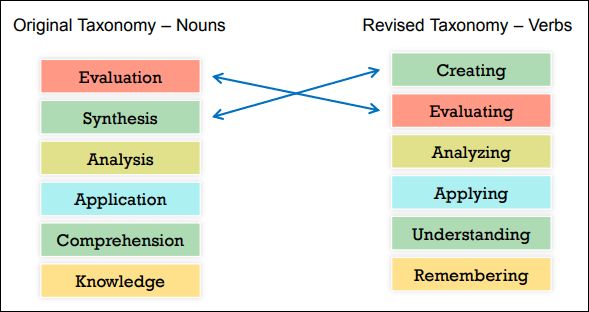
This new, revised form of the taxonomy is considered more accurate and reflects more active thinking.
A detailed description of the cognitive domains is as follows:-
1. Remember
,i.e., recall/ retrieval of information read. It includes reciting rules, quoting a statement, etc. E.g. a student being able to recite Newton's laws.
2. Understand
, i.e., generalizing / summarising / translating the problem in own words, comprehension of the meaning. E.g. student being able to explain Newton's laws in own words.
3. Apply
, i.e., compute/ predict / relate /construct /solve ; use the concept to solve a problem. E.g. student being able to calculate acceleration, kinetic energy.
4. Analyse
, i.e. classification / simplification / categorisation so that organisational structure may be understood. E.g., student being able to differentiate between kinetic energy and potential energy.
5. Evaluate
, i.e., choose / justify / select / compare / contrast / judge the idea and decide what steps are to be taken. E.g. student being able to decide the most effective solution by choosing to use conservation of energy or conservation of momentum.
6. Create
,i.e., put parts together to develop a new whole, like writing a new essay, designing a homework problem on Newton's laws, revising a process to improve the outcome.
So, now we know -
Before understanding a concept, you must remember it.
In order to apply a concept you must first understand it.
To evaluate a process, you must have analyzed it.
To create/ reach to an accurate conclusion or revise an existing conclusion, you must have completed a thorough evaluation.
Hence, Bloom’s taxonomy is a powerful tool to help develop learning objectives because it actually explains the process of learning. Happy Learning!!
Recommended

You Are My Soniya Chords - Alka Yagnik & Sonu Nigam - Kabhi Khushi Kabhi Gham