Artificial Intelligence

May 06, 2019 • 33 views
Artificial intelligence is any task performed by a program or a machine that, if a human carried out the same activity, we would say the human had to apply intelligence to accomplish the task.
AI systems will typically demonstrate at least some of the following behaviors associated with human intelligence: planning, learning, reasoning, problem solving, knowledge representation, perception, motion, and manipulation and, to a lesser extent, social intelligence and creativity.
Artificial intelligence is a branch of computer science that aims to create intelligent machines. It has become an essential part of the technology industry.

Research associated with artificial intelligence is highly technical and specialized. The core problems of artificial intelligence include programming computers for certain traits such as:
Knowledge
Reasoning
Problem solving
Perception
Learning
Planning
Ability to manipulate and move objects

At a very high level artificial intelligence can be split into two broad types: narrow AI and general AI.
Knowledge engineering is a core part of AI research. Machines can often act and react like humans only if they have abundant information relating to the world. Artificial intelligence must have access to objects, categories, properties and relations between all of them to implement knowledge engineering. Initiating common sense, reasoning and problem-solving power in machines is a difficult and tedious task.
Machine learning is also a core part of AI. Learning without any kind of supervision requires an ability to identify patterns in streams of inputs, whereas learning with adequate supervision involves classification and numerical regressions. Classification determines the category an object belongs to and regression deals with obtaining a set of numerical input or output examples, thereby discovering functions enabling the generation of suitable outputs from respective inputs. Mathematical analysis of machine learning algorithms and their performance is a well-defined branch of theoretical computer science often referred to as computational learning theory.
Machine perception deals with the capability to use sensory inputs to deduce the different aspects of the world, while computer vision is the power to analyze visual inputs with a few sub-problems such as facial, object and gesture recognition.
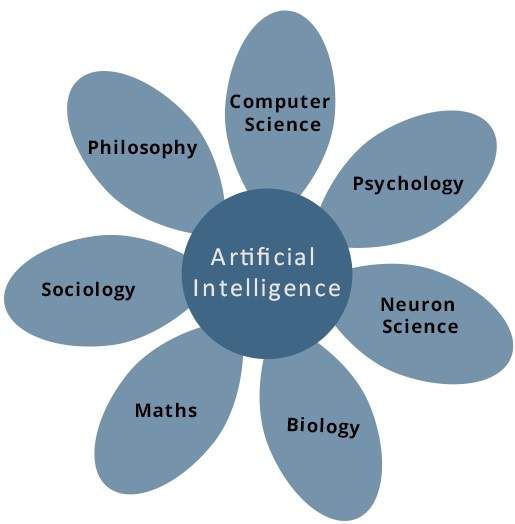
Goals of AI
To Create Expert Systems − The systems which exhibit intelligent behavior, learn, demonstrate, explain, and advice its users.
To Implement Human Intelligence in Machines − Creating systems that understand, think, learn, and behave like humans.
Robotics is also a major field related to AI. Robots require intelligence to handle tasks such as object manipulation and navigation, along with sub-problems of localization, motion planning and mapping.
Narrow AI is what we see all around us in computers today.
Applications of AI
AI has been dominant in various fields such as −
Gaming − AI plays crucial role in strategic games such as chess, poker, tic-tac-toe, etc., where machine can think of large number of possible positions based on heuristic knowledge.
Natural Language Processing − It is possible to interact with the computer that understands natural language spoken by humans.
Expert Systems − There are some applications which integrate machine, software, and special information to impart reasoning and advising. They provide explanation and advice to the users.
Vision Systems − These systems understand, interpret, and comprehend visual input on the computer.
Speech Recognition − Some intelligent systems are capable of hearing and comprehending the language in terms of sentences and their meanings while a human talks to it. It can handle different accents, slang words, noise in the background, change in human’s noise due to cold, etc.
Handwriting Recognition − The handwriting recognition software reads the text written on paper by a pen or on screen by a stylus. It can recognize the shapes of the letters and convert it into editable text.

Artificial general intelligence is very different, and is the type of adaptable intellect found in humans.This is the sort of AI more commonly seen in movies, the likes of HAL in 2001 or Skynet in The Terminator.
Recommended
