Why Player Engagement, Not Just Payouts, Defines The Future Of Online Slot Entertainment

Jun 25, 2026 • 1 view

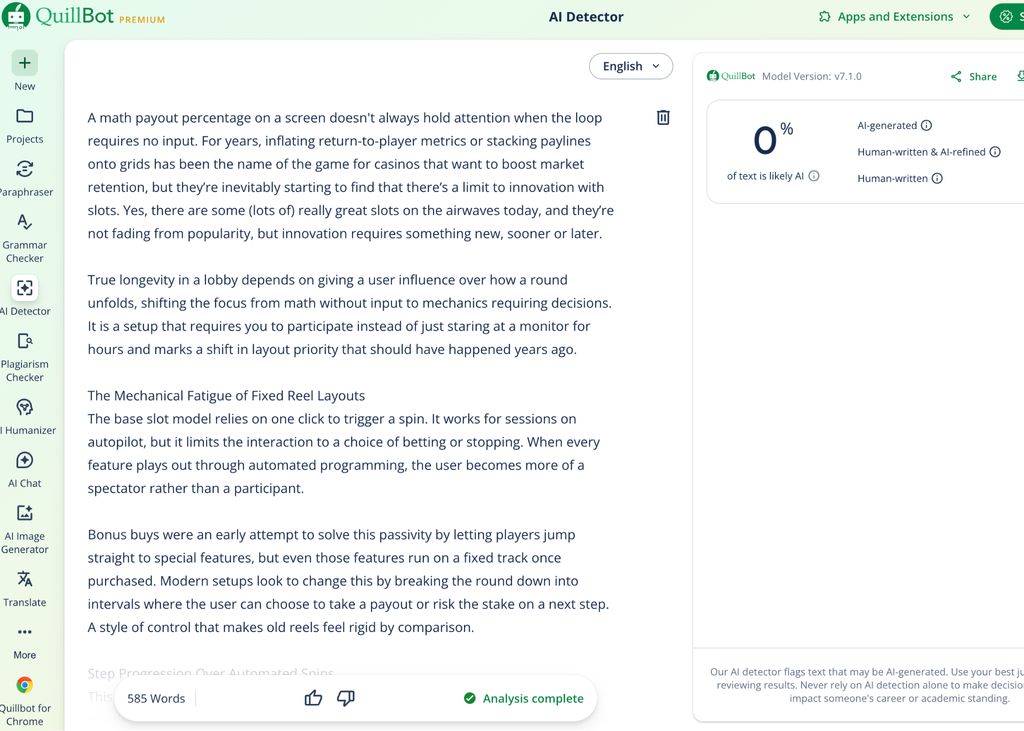
A math payout percentage on a screen doesn't always hold attention when the loop requires no input. For years, inflating return-to-player metrics or stacking paylines onto grids has been the name of the game for casinos that want to boost market retention, but they’re inevitably starting to find that there’s a limit to innovation with slots. Yes, there are some (lots of) really great slots on the airwaves today, and they’re not fading from popularity, but innovation requires something new, sooner or later.
True longevity in a lobby depends on giving a user influence over how a round unfolds, shifting the focus from math without input to mechanics requiring decisions. It is a setup that requires you to participate instead of just staring at a monitor for hours and marks a shift in layout priority that should have happened years ago.
Mechanics, Progression, and Risk profiles
The base slot model relies on one click to trigger a spin. It works for sessions on autopilot, but it limits the interaction to a choice of betting or stopping. When every feature plays out through automated programming, the user becomes more of a spectator rather than a participant.
Bonus buys were an early attempt to solve this passivity by letting players jump straight to special features, but even those features run on a fixed track once purchased. Modern titles like the Chicken Road game change this by breaking the round down into intervals where the user can choose to take a payout or risk the stake on a next step. A style of control that makes old reels feel rigid by comparison.
This shift toward design focused on interaction is clear in how titles utilize path-clearing mechanics rather than wheels to distribute multipliers, because the interface requires you to guide a character across a field where hazards are hidden under specific coordinates.
Every step forward advances the multiplier, but it carries the risk of hitting a trap that resets the round. The interaction centers on the option to pause between steps, evaluate the return, and decide whether to progress or cash out. This setup forces you to weigh the probability of the path line by line rather than letting a program run on a loop which is much more involving than watching fruit match up on a payline.
The ability to modify the math setup of a game on the fly is the baseline expectation for users who want control over their sessions. In classic configurations, the volatility is locked into the software from the factory, forcing everyone into the same frequency of wins and losses regardless of preference.
Formats solve this by letting the player select the density of hazards on the grid before a round starts, which alters the multiplier steps across the entire path. The system lets you tailor the interaction based on your goals for that specific turn - whether you want low-density setups (fewer traps mean a higher probability of completing a path, meaning small multiplier gains) or high-density setups that spike the risk instantly, meaning a single successful step gets you a much larger payout.
This choice means the platform serves as a tool for your style, allowing you to alternate between variance levels as your balance dictates. The type of flexibility that makes standard layouts look out of date.
Recommended

You Are My Soniya Chords - Alka Yagnik & Sonu Nigam - Kabhi Khushi Kabhi Gham
Kasam Ki Kasam Chords - A.R.Rahman & Shaan - Kabhi Khushi Kabhi Gham
Janiye Chords - Chor Nikal Ke Bhaga - Yami Gautam & Sunny Kaushal