Additive Or Multiplicative? Why Slot Multipliers Don’T Always Stack The Same Way

Sep 25, 2026 • 0 views
Slot multipliers look simple until several appear during the same feature. The numbers are look straightforward, but the calculation behind them changes from one game to the next. A quick look at the rules tells you whether those values are added or multiplied, and whether the total carries into another win.
A multiplier lands during a pokie bonus, then another appears on the next cascade. You add 2x and 3x and expect 5x, but the game displays 6x because it multiplied the two values. The result comes from the rules behind the feature. Additive systems combine the numbers; multiplicative systems apply both multipliers to the win.
The trouble is that the reels do not always tell you which calculation is running underneath. A large 3x symbol shows the value, while the paytable explains where it applies. The multiplier may affect a single symbol or the whole win. Another rule may apply it to the amount carried into the next cascade.
Two Multipliers Can Produce Different Totals
Start with a NZ$10 win and two multiplier symbols: 2x and 3x. An additive game joins the values to make 5x, producing NZ$50. A multiplicative game applies both values, so 2 × 3 becomes 6x and the same NZ$10 win becomes NZ$60.
The distinction is useful when browsing the video and Megaways pokies available at SpinBit casino. Its catalogue contains more than 9,000 pokies, including games with cascading wins and increasing multipliers. Those features can keep a multiplier active while symbols fall away and a new result forms, although the exact rule belongs to the individual game. A number carried through several cascades works differently from a multiplier attached to one completed win.
There is another wrinkle. A game can add new values to a running meter that began at 1x, which means collecting 2x and 3x may produce 6x rather than 5x. The screen is adding the awards correctly: 1 + 2 + 3 = 6.
The Same Symbols Can Follow Different Rules
The symbols may match while the calculation behind them changes. Four common systems show where the differences enter:
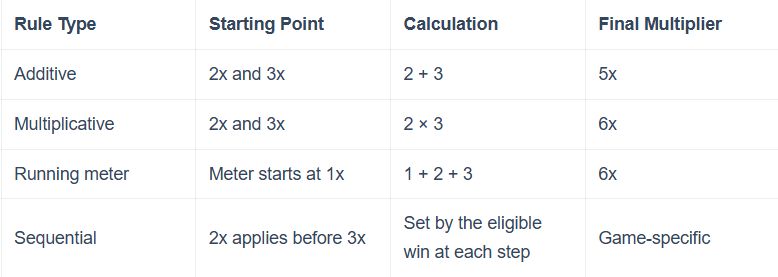
Sequential play needs the closest reading. A 2x multiplier may settle the first cascade before a 3x value applies to the next one. Another rule set may carry the adjusted total forward, allowing the 3x multiplier to act on an amount that has already doubled. Both games can display the same symbols while producing different totals because each multiplier is acting on a different amount.
The difference is much the same as adding two discounts to a price and applying one discount after the other. The percentages on the label have not changed, but the second calculation begins from a new figure. In a pokie, the order of events plays the same role.
The Game Engine Decides What Carries Forward
Behind the reels, the game engine checks a set of instructions whenever a multiplier appears. It identifies the eligible win and applies the stated calculation, then decides whether the new value survives the next event. A counter may reset after one cascade or remain active for the full bonus round. Another rule may stop it at a fixed ceiling.
Clear game information depends on structured content that stays consistent when a catalogue is updated or displayed on another screen. An explanation of that operational process shows why organised game data supports live gaming services.
That organisation is visible in the SpinBit lobby, where players can filter pokies by category, provider, theme or feature, then sort the results by RTP or volatility. A separate option orders them by popularity. Finding a multiplier game through a feature filter is the first step; its paytable then tells you whether the value applies to a symbol or a cascade. A separate rule may cover the complete bonus win. Reading that one line prevents most disagreements with the total shown on screen.
Reward Cues Catch Attention Before Arithmetic Does
Multiplier symbols are made to catch the eye quickly. The large number arrives with an animation at the winning moment; the calculation follows in a fraction of a second. Your attention reaches the reward cue before you have worked through the rule behind it.
A 2017 eye-tracking experiment by Stephan Koenig and researchers at Philipps-Universität Marburg examined the effects of reward expectancy and uncertainty on attention. The experiment began with 33 participants; nine were excluded after their results showed poor learning, leaving 24 in the final analysis. The uncertain cue delivered a high reward on 50% of trials, while eye position was sampled at 1,000Hz. Reward expectancy affected which cue first caught the eye, whereas uncertainty affected how long the viewer remained focused on it.
The point reaches beyond a laboratory task. A multiplier carries an immediate promise of a larger result, so the bright number wins your attention before the rule text does. Confusion begins when the visual cue is clear but its scope is not.
Game-UX and cognitive-psychology expert Dr Celia Hodent explained the issue in 2015: “Perception is a construction of the brain. UX will help you figure out faster and more precisely what the real problems are.” Her original discussion concerned player feedback and game design. Applied here, the perceived problem is an incorrect total; the actual cause is usually a missed rule about calculation order or persistence.
A Quick Check Beats Mental Multiplication
Multiplication becomes difficult to judge once values begin building on earlier values. Martin Schonger and Daniela Sele tested this wider problem in a 2021 study of exponential-growth bias. Their experiment included 227 participants, divided into groups of 111 and 116. In one question, the correct low-growth result after 30 days was about 13,000, yet the median answer from the growth-rate group was 5,000. Between 83% and 91% of participants also recognised that other people would underestimate exponential growth.
The study did not examine pokies, but its central finding applies to the arithmetic: people underestimate results that build through repeated multiplication. A paytable therefore gives you a safer answer than instinct.
Before playing a multiplier feature, check:
What value receives the multiplier?
Are the displayed values added or multiplied?
Does the value remain active for another cascade?
When does the counter reset?
Is there a maximum value?
New pokies are added regularly to SpinBit’s catalogue, and each release can use its own feature logic. Rules remembered from an older game cannot settle the calculation in a new title; the current paytable can.
The Paytable Has the Final Answer
A multiplier symbol tells you the size of an award, while the paytable tells you how the game uses it. Check the starting value and the eligible win before the feature begins, then find the reset point. That short read explains whether 2x and 3x become 5x or 6x, leaving the reels to provide the entertainment rather than an argument about the arithmetic.
Gambling is entertainment. Set personal spending and time limits, and stop playing when it is no longer enjoyable.
Recommended

You Are My Soniya Chords - Alka Yagnik & Sonu Nigam - Kabhi Khushi Kabhi Gham
Kasam Ki Kasam Chords - A.R.Rahman & Shaan - Kabhi Khushi Kabhi Gham
Janiye Chords - Chor Nikal Ke Bhaga - Yami Gautam & Sunny Kaushal